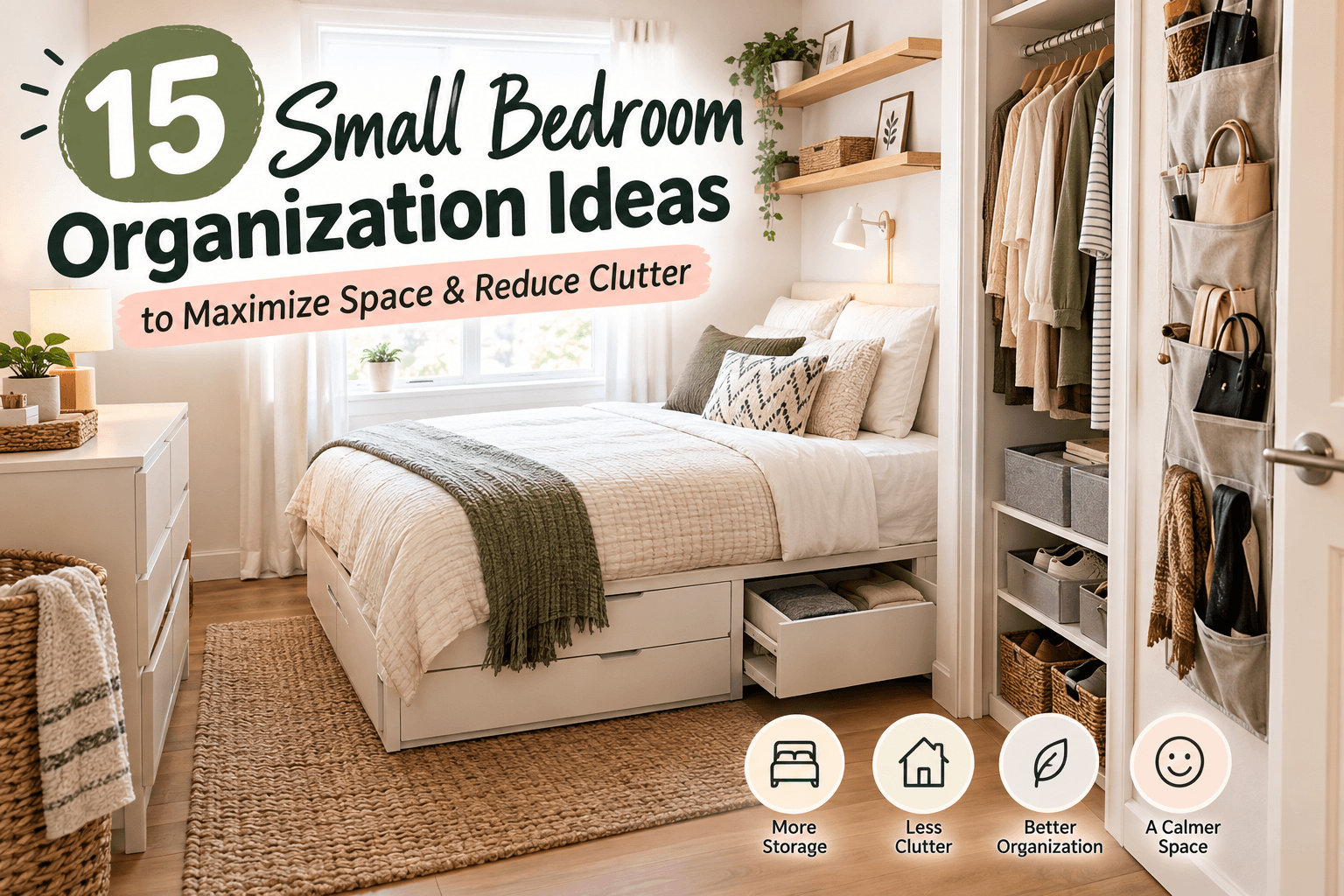
A small bedroom can feel crowded surprisingly quickly. Clothes pile up, shoes take over the floor, accessories get scattered across surfaces, and storage seems to disappear faster than you can use it. The good news is that you don’t necessarily need a larger room or expensive furniture to create a more organized space.
The key is to use the space you already have more efficiently. Hidden areas, vertical walls, doors, corners, drawers, and the space underneath your bed can all become useful storage areas when organized properly.
In this guide, you’ll find 15 practical small bedroom organization ideas designed to help you reduce clutter, free up floor space, and make everyday items easier to find.
1. Make Use of Under-Bed Storage
The space underneath your bed is one of the easiest areas to overlook. Instead of allowing dust to collect underneath it, turn this hidden space into practical storage.
Use shallow storage boxes, baskets, or containers for items you don’t need every day. Seasonal clothing, spare bedding, blankets, bags, and other less frequently used belongings can be stored underneath the bed.
Choose containers that are easy to pull out so you don’t have to move the bed whenever you need something.
Tip: Label storage containers so you can quickly identify what’s inside.
Just as overlooked areas can provide useful storage in the bedroom, you can also make better use of hidden areas elsewhere in the home with these under-sink organization ideas.
2. Use Vertical Wall Space
When floor space is limited, look upward.
Walls can provide valuable storage without taking up much floor area. Depending on your bedroom layout, you can use shelves, hooks, wall organizers, or other vertical storage solutions for items that would otherwise occupy desks, chairs, or the floor.
Wall storage can be especially useful for books, small accessories, bags, and decorative items.
However, avoid filling every available wall with shelves. A few carefully chosen storage areas can be more useful than a crowded wall.
3. Organize Your Closet by Category
A messy closet can make a small bedroom feel even smaller.
Instead of placing clothes wherever there is an empty space, organize them by category. For example, keep everyday clothing together, separate seasonal items, and give accessories their own area.
You can also arrange clothing based on how frequently you use it. Everyday items should be easiest to reach, while special-occasion or seasonal clothing can be placed in less accessible areas.
If your closet has unused vertical space, consider adding suitable organizers or additional shelves rather than immediately buying a larger wardrobe.
4. Use the Back of the Bedroom Door
The back of a bedroom door is another overlooked area that can provide extra storage.
Depending on the type of organizer you use, this space can hold bags, scarves, accessories, lightweight clothing, or other small items.
This is particularly useful when your bedroom doesn’t have enough floor space for another cabinet or rack.
Tip: Before installing anything, make sure the organizer doesn’t interfere with the door closing properly.
5. Keep Shoes Off the Floor
Shoes scattered around the bedroom can quickly make the room look untidy and reduce usable floor space.
Instead of keeping every pair on the floor, consider a compact shoe rack, vertical organizer, or suitable behind-the-door storage.
Keep the shoes you wear most often somewhere accessible and move seasonal or rarely worn footwear into less accessible storage.
This simple change can make the bedroom floor feel noticeably more open.
6. Add Storage to the Bedside Area
Your bedside area can become cluttered with books, chargers, glasses, skincare products, and other everyday items.
Rather than allowing everything to accumulate on the bedside table, create a simple system for frequently used belongings.
A compact bedside organizer, small basket, shelf, or storage table can help keep these items together.
The goal isn’t to store everything beside your bed. Keep only the things you regularly use there and move everything else to its proper location.
7. Use Drawer Dividers for Small Items
Drawers can hold a surprising amount, but without organization, small items quickly become mixed together.
Drawer dividers can separate socks, underwear, accessories, stationery, or other small belongings into individual sections.
This makes it easier to find what you need without emptying the entire drawer.
If you don’t want to purchase additional organizers, small existing boxes or containers can sometimes be used to create separate sections.
The same space-saving approach can also work in the kitchen. Explore these small kitchen storage ideas for making better use of limited space.
8. Create a Dedicated Place for Bags and Accessories
Handbags, backpacks, belts, scarves, and other accessories can easily end up on chairs, beds, or the floor.
Give these items a dedicated storage area instead.
Hooks can work well for frequently used bags, while baskets or organizers can keep smaller accessories together.
Try to avoid creating one large “everything” basket. Separating different types of accessories makes it much easier to maintain the organization over time.
9. Choose Multi-Purpose Furniture
When a bedroom is small, every piece of furniture takes up valuable space.
That’s why multi-purpose furniture can be useful. A storage ottoman, storage bench, bed with built-in storage, or compact bedside table can provide more than one function.
For example, instead of having a separate seat and storage container, a storage bench may provide both.
Before adding another piece of furniture, ask yourself:
Can something I already need also provide storage?
If the answer is yes, you may be able to save both floor space and money.
10. Create a Small Laundry Zone
Clothes that are waiting to be washed often end up on the floor, chair, or side of the bed.
A dedicated laundry basket or hamper gives dirty clothing one specific place to go.
Choose a size that fits your available space rather than buying the largest hamper you can find. A slim or compact option may work better in a small bedroom.
The important part is consistency: once clothes are dirty, put them directly into the laundry area rather than leaving them around the room.
11. Make Use of Unused Corners
Bedroom corners often become empty spaces simply because standard furniture doesn’t fit well there.
Depending on the size and layout of your room, a corner can potentially accommodate a narrow shelf, compact rack, small storage unit, or suitable organizer.
Don’t automatically fill every empty corner, though. Empty space can also make a small room feel more open.
The goal is to use a corner when it solves a genuine storage problem—not simply because there is space available.
12. Store Seasonal Items Separately
One reason small bedrooms become cluttered is that everyday storage is often filled with items that aren’t currently being used.
Winter clothing doesn’t need to occupy the easiest-to-reach storage area during warmer months. Likewise, summer clothing can be moved aside when colder weather arrives.
Store seasonal belongings in labeled containers, under-bed storage, higher shelves, or another suitable area.
When the season changes, swap the items rather than keeping everything in your everyday storage at the same time.
This can make limited closet and drawer space much easier to manage.
13. Create a Simple Decluttering System
Organization isn’t only about buying storage products.
If you keep adding organizers without removing things you no longer need, your bedroom can eventually become crowded with both belongings and storage containers.
A simple system can help:
Keep
Items you use regularly or genuinely need.
Relocate
Items that belong somewhere else in your home.
Donate
Useful belongings you no longer need.
Discard
Broken, damaged, or unusable items that no longer serve a purpose.
You don’t have to declutter the entire bedroom in one day. Start with one drawer, shelf, or corner and work through the room gradually.
If you’re working on other compact spaces around your home, check out these practical small bathroom organization ideas for reducing clutter and making better use of limited space.
14. Keep Frequently Used Items Within Easy Reach
A well-organized bedroom shouldn’t make everyday life harder.
Items you use frequently should be easy to access. Items you rarely use can be stored in less accessible locations.
For example, everyday clothing can stay in your main closet or drawers, while seasonal blankets can go under the bed.
This simple principle prevents you from constantly moving storage containers around just to reach the things you use every day.
Think of your storage in three levels:
Daily use → Easy access
Occasional use → Moderate access
Rare or seasonal use → Hidden storage
This approach can make a small bedroom much easier to maintain.
15. Choose Storage That Matches Your Available Space
One of the biggest mistakes people make when organizing a small bedroom is buying storage first and figuring out where to put it later.
Instead, measure your available space before choosing an organizer.
Ask yourself:
- What exactly do I need to store?
- How much space is available?
- Can I use vertical or hidden space instead?
- Will this organizer make the room feel more crowded?
- Can I access the items easily?
- Do I actually need another storage product?
For example, a narrow wall organizer may make more sense than a bulky cabinet if floor space is limited.
The best storage solution isn’t necessarily the largest one. It’s the one that solves your specific storage problem while fitting comfortably into your room.
Small Bedroom Storage Products Worth Considering
Once you’ve identified the areas causing the most clutter, the right storage products can make the organization system easier to maintain.
Depending on your bedroom, useful categories may include:
- Under-bed storage organizers
- Drawer dividers
- Compact shoe racks
- Wall-mounted organizers
- Over-the-door organizers
- Storage baskets
- Closet organizers
- Hooks and hanging storage
- Compact storage racks
The important thing is to choose products based on your actual storage needs and available space.
For example, if shoes are the main problem, focus on shoe storage rather than buying a general organizer that doesn’t solve the issue. If small accessories are getting mixed together, drawer organizers may be more useful.
At ZK Home Essentials, our goal is to help you find practical home products that make everyday spaces more organized and functional.
How to Keep a Small Bedroom Organized
Organizing your bedroom once is helpful, but maintaining it is what makes the biggest difference.
Try these simple habits:
Keep the floor clear
Return shoes, bags, clothing, and other items to their designated places instead of allowing them to accumulate on the floor.
Put things back after use
A storage system only works when items actually return to their assigned locations.
Do a quick weekly reset
Spend a few minutes returning misplaced items, organizing surfaces, and checking problem areas.
Review your belongings regularly
If you haven’t used something for a long time, consider whether you still need it.
Don’t overfill your storage
A drawer or basket that’s packed beyond its capacity is difficult to maintain. Leave enough room to access what you need.
Remember, the goal isn’t to make your bedroom look perfectly organized every minute of the day. The goal is to create a simple system that’s easy enough to maintain in everyday life.
Final Thoughts
A small bedroom doesn’t have to feel cramped or difficult to maintain. The key is to make smarter use of the space you already have rather than simply adding more furniture or storage.
Start with the biggest source of clutter, remove things you no longer need, and then use hidden areas, vertical space, drawers, doors, and corners more efficiently. Keep everyday items within easy reach and store seasonal or rarely used belongings where they won’t take up valuable everyday space.
Most importantly, choose storage solutions based on your actual needs and available space. A simple, practical organization system that you can maintain is far more useful than a room filled with storage products.
If you’re also looking for practical products that can make everyday household tasks easier, explore these smart home essentials.
With a few thoughtful changes, even a small bedroom can become more functional, comfortable, and clutter-free. 🏠✨
Frequently Asked Questions
How do I organize a very small bedroom?
Start by removing items you no longer use, then focus on hidden and vertical storage. Use areas such as underneath the bed, the back of the door, closet space, drawers, and unused corners. Keep frequently used items accessible and store seasonal belongings in less accessible areas.
How can I maximize space in a small bedroom?
Make better use of space that doesn’t require additional floor area. Under-bed storage, vertical wall storage, over-the-door organizers, compact shelves, and multi-purpose furniture can help you use your existing space more efficiently.
How do I organize a small bedroom with little storage?
Start by decluttering and identifying what you actually need to store. Then use hidden storage, vertical space, drawer organizers, hooks, baskets, and other compact solutions. You can also rotate seasonal belongings so that only currently useful items occupy your main storage areas.
What storage is best for a small bedroom?
The best storage depends on what you’re trying to organize and how much space you have. Under-bed organizers work well for less frequently used items, drawer dividers help with smaller belongings, compact shoe racks can reduce floor clutter, and wall or door organizers can add storage without using much floor space.
How can I keep a small bedroom from becoming cluttered?
Give everything a designated place and return items after using them. Keep frequently used belongings easy to reach, avoid buying unnecessary storage products, and regularly remove items you no longer use. A short weekly reset can also prevent small amounts of clutter from becoming a bigger problem.
How can I organize a small bedroom on a budget?
Start with decluttering and rearranging before buying anything. Reuse suitable boxes and baskets you already own, make better use of existing shelves and drawers, and prioritize inexpensive solutions such as hooks, dividers, and compact organizers. Buy new storage products only when they solve a specific problem.