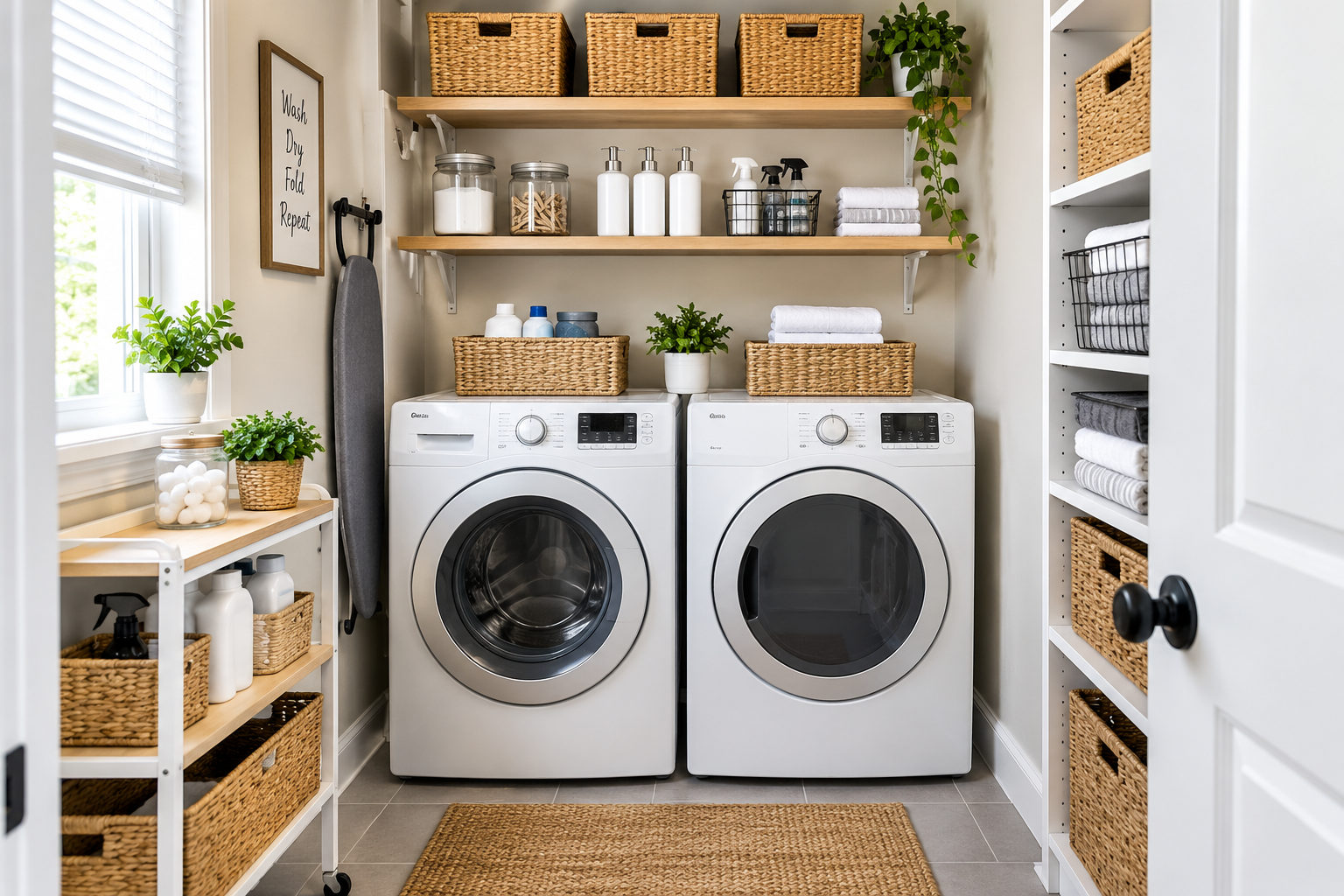
A small laundry room can become cluttered quickly when detergent bottles, laundry baskets, cleaning supplies, and freshly washed clothes all compete for the same limited space. Without a clear system, even simple laundry tasks can feel more difficult than they need to be.
The good news is that small laundry room organization does not have to involve an expensive renovation or a complete room makeover. With thoughtful storage, a few space-saving products, and a better arrangement of everyday essentials, you can make a compact laundry area more functional.
Whether you have a narrow laundry room, a laundry closet, a basement washing area, or a small corner of your home dedicated to laundry, these 15 practical ideas can help you use the space you already have.
For more inspiration, you can also explore these small laundry room ideas and tips when planning your storage layout.
Affiliate Disclosure: This article may contain affiliate links. If you purchase through these links, ZK Home Essentials may earn a commission at no additional cost to you. We only aim to recommend practical products that may help make your home more organized.
1. Use Vertical Space for Laundry Storage
When floor space is limited, look at the walls. Vertical storage allows you to keep frequently used supplies accessible without filling the floor with extra cabinets or containers.
Consider installing shelves above or beside your washer and dryer, provided the installation is suitable for the wall and appliance layout.
Use the shelves for:
- Laundry detergent and fabric-care products
- Small baskets for stain-removal supplies
- Reusable laundry bags
- Spare hangers and clothespins
- Less frequently used laundry accessories
Practical tip: Keep everyday supplies on a comfortably reachable shelf. Store lightweight backup items higher up, and avoid placing heavy containers where they could fall.
If you rent your home, consider a freestanding shelving unit or another removable solution before drilling into walls.
2. Install a Shelf Above the Washer and Dryer
The area above your appliances can be useful storage space, especially when there is little room for a separate cabinet.
A properly installed shelf can hold baskets, laundry supplies, and other lightweight essentials. Before buying one, measure the available width and depth and check the appliance manufacturer’s clearance requirements.
Choose a shelf that:
- Fits the available wall space
- Leaves appliance doors and lids unobstructed
- Is securely anchored to a suitable wall structure
- Keeps products away from heat and moisture where necessary
For a coordinated appearance, place smaller supplies in matching baskets or labeled bins.
Affiliate product idea: A wall-mounted laundry shelf or adjustable shelving system may be useful for readers who need additional storage. Link to a product only after checking its dimensions, mounting requirements, load capacity, and compatibility with the intended space.
The same space-saving approach can work in other compact areas of your home, so take a look at these small bathroom organization ideas for more ways to keep everyday essentials neatly arranged.
3. Choose a Slim Rolling Cart for Narrow Gaps
Is there a narrow gap beside your washer or dryer? A slim rolling cart may turn that unused area into practical storage.
These carts commonly have multiple tiers, making them suitable for grouping laundry supplies vertically. Some designs include wheels, allowing the cart to be moved when necessary.
Before purchasing, measure the gap at its narrowest point. Remember to account for handles, wheels, hoses, and any movement required to access the appliances.
Use the cart for:
- Detergent and fabric-care products
- Lint rollers and garment-care accessories
- Laundry bags and clothespins
- Small, frequently used cleaning supplies
Avoid placing the cart where it blocks appliance ventilation, service access, or a walkway.
Best for: Narrow laundry rooms and compact laundry closets with a suitable side gap.
4. Use Baskets to Group Laundry Supplies
Small items are easier to manage when similar products have a designated home. Instead of keeping everything scattered across a shelf, group supplies into a few practical categories.
For example:
| Basket or bin | What to store |
|---|---|
| Washing supplies | Detergent and approved laundry additives |
| Stain care | Stain-removal products and a soft laundry brush |
| Drying accessories | Clothespins and reusable drying accessories |
| Garment care | Lint rollers and fabric-care tools |
| Small items | Mesh laundry bags and spare accessories |
Choose baskets that fit your shelves rather than buying containers first and trying to make them fit afterward.
Labels can help other household members return supplies to the correct place. You do not need a separate basket for every product; too many containers can create more clutter instead of solving it.
Budget-friendly idea: Reuse clean, suitable containers you already own before purchasing new organizers.
5. Create a Simple Laundry Sorting System
Sorting clothes before washing can help keep laundry organized and reduce the need to rearrange piles throughout the room.
A divided hamper is one option. Another is to use two or three separate laundry bags, depending on your household’s washing routine.
You might sort laundry into:
- Everyday clothing
- Towels and bedding
- Delicates or items requiring special care
Follow garment care labels and sort items according to color, fabric, and washing requirements when appropriate.
If a multi-compartment hamper takes up too much floor space, use separate collapsible laundry bags or keep a small number of bags in a closet until they are needed.
Product to consider: A narrow or divided laundry hamper can be useful when its dimensions fit the room and it provides enough capacity for your household.
6. Add a Folding Surface Without Building a Large Counter
A dedicated folding surface makes it easier to handle clean clothes before carrying them to bedrooms or closets.
In a small laundry room, a full countertop may not be practical. Consider alternatives such as:
- A fold-down wall-mounted table
- A compact folding table that can be stored after use
- A suitable countertop over front-loading appliances
- A nearby clear surface used exclusively for folding during laundry time
If you place a countertop over appliances, check the appliance manufacturer’s installation instructions and required clearances first. Make sure the surface is supported independently and does not interfere with appliance movement, servicing, or ventilation.
Remember that top-loading washers need adequate space for the lid to open fully.
Small-space tip: Keep the folding area clear of detergent bottles and miscellaneous household items. Its usefulness depends on having room to fold clothes comfortably.
7. Make Air-Drying Easier With a Foldable Rack
Some clothing and household textiles need to air-dry rather than go into a tumble dryer. A permanent drying rack can occupy valuable floor space in a compact laundry room.
A foldable or wall-mounted drying rack may offer a more flexible solution.
Possible options include:
- A folding floor rack that can be stored after use
- A properly installed wall-mounted rack
- A retractable clothesline where the layout permits
- A compact rack designed for smaller loads
Before choosing a rack, consider the length and weight of the items you need to dry, the available space when it is open, and the manufacturer’s installation instructions.
Important: Wet laundry adds weight, and drying clothes indoors adds moisture to the surrounding air. Allow adequate ventilation and avoid placing damp laundry where it could contribute to persistent condensation or mold.
8. Use the Back of the Door Carefully
The back of a laundry room door may provide additional storage without using floor space.
Depending on the door and available clearance, you could use:
- An over-door hook rack
- A lightweight organizer for appropriate accessories
- Hooks for reusable laundry bags
- A holder for an ironing board designed for that purpose
Measure the space between the door and nearby appliances, shelves, or walls before choosing an organizer.
Check the door’s construction and the product’s weight limits. Avoid hanging heavy containers or hazardous products where they could fall, and make sure the door can still open and close freely.
For rental homes, removable hooks may be useful if the surface and product instructions allow them.
9. Organize a Laundry Closet With a Clear Layout
Not every home has a separate laundry room. Some washing machines are installed in closets, hallways, bathrooms, or small utility alcoves.
In these spaces, the layout matters as much as the storage products.
Start by identifying the areas needed for:
- Loading and unloading the machines
- Storing frequently used supplies
- Holding dirty laundry
- Handling clean clothes
- Accessing hoses, vents, electrical connections, and service panels
For a stacked washer and dryer, a narrow shelving unit or suitable wall storage may work better than a countertop. For side-by-side front-loaders, a folding surface may be more practical if there is enough room.
Do not install shelves or organizers that prevent you from accessing the appliances for maintenance.
Practical tip: If the closet is very tight, keep only frequently used laundry supplies nearby and store backup products elsewhere.
If you’re looking for more ways to make the most of limited space throughout your home, explore these practical kitchen organization ideas for inspiration.
10. Make Use of Cabinet Doors and Existing Cabinets
If your laundry room already has cabinets, organize their interiors before adding more storage furniture.
Small bins, shelf dividers, and appropriately sized organizers can help separate supplies that would otherwise become mixed together.
You could dedicate different areas to:
- Everyday detergent and fabric care
- Laundry bags and garment-care tools
- Backup supplies
- Household cleaning cloths and related accessories
Where suitable, the inside of a cabinet door can hold lightweight items using an organizer designed for that purpose.
Avoid overloading shelves or attaching products to cabinet doors without checking their construction and mounting limitations.
Budget tip: Rearranging existing cabinets may be enough to create usable space, so measure and declutter before buying new organizers.
11. Use Stackable Bins for Backup Supplies
Extra detergent, stain removers, and laundry accessories can quickly take over the most accessible shelves.
Stackable bins can help contain backup supplies while keeping everyday products within reach. Choose sturdy containers that are designed to stack safely and fit the available shelf depth.
A simple system might include:
- One bin for unopened laundry products
- One for spare bags and accessories
- One for seasonal or infrequently used items
Keep containers stable and within a safe lifting height. Avoid stacking heavy products overhead or placing containers where they block access to appliance controls.
Safety reminder: Keep laundry products in their original, labeled packaging whenever practical. Store them according to their labels and away from children and pets. Never transfer chemicals into food or drink containers.
12. Keep Hangers and Small Laundry Accessories Together
Hangers, clothespins, mesh bags, lint rollers, and small garment-care tools are easy to misplace when they do not have a designated storage spot.
Use a small basket, drawer organizer, or hook system to keep these items together.
For example:
- Hang reusable laundry bags on a suitable hook.
- Store clothespins in a small container near the drying rack.
- Keep mesh bags together in a labeled basket.
- Place lint rollers and fabric-care tools in a dedicated drawer.
Choose a location that matches your routine. If you hang clothes immediately after drying, keep suitable hangers near the dryer or folding area.
The goal is not to create more storage categories than you need. It is to make frequently used accessories easy to find and put away.
13. Choose Storage That Fits Your Budget
An organized laundry room does not need to contain expensive cabinetry or matching designer containers.
Start with the problems you experience most often and choose solutions that fit your available space.
| Problem | Lower-cost option | Alternative if space allows |
|---|---|---|
| Supplies clutter the appliance tops | Reuse suitable baskets | Install a properly supported shelf |
| Laundry piles up on the floor | Reuse a hamper or bag | Choose a compact divided hamper |
| Small items are hard to find | Repurpose small containers | Use labeled drawer organizers |
| No folding area | Clear an existing surface | Add a fold-down table |
| No space for air-drying | Use a rack that folds away | Install a suitable wall-mounted rack |
| Narrow gap beside appliances | Store items elsewhere | Add a slim rolling cart |
Before buying a product, ask yourself whether it solves a specific problem. If an existing basket or shelf already works, replacing it with a new organizer may not provide much additional value.
Making a small room feel more spacious often comes down to choosing smart storage solutions, and these small bedroom organization ideas offer more inspiration for reducing clutter and using space efficiently.
14. Make a Small Laundry Room Feel More Open
Organization is not only about adding storage. Removing unnecessary items and keeping surfaces clear can also make a compact space easier to use.
Try these simple changes:
- Remove empty packaging and unused laundry products.
- Keep the floor as clear as possible.
- Group similar supplies rather than spreading them across multiple surfaces.
- Use a consistent set of containers where practical.
- Keep frequently used items accessible.
- Store backup supplies outside the room if necessary.
- Avoid filling every available wall with shelves.
If you want a more coordinated appearance, use a limited color palette for baskets and labels. However, function should come first: containers must fit, remain stable, and be suitable for their intended contents.
You can also use brighter lighting where appropriate, provided the fixture is suitable for the location. Good visibility makes it easier to read product labels and find small items.
15. Follow a Simple Laundry Room Reset Routine
Even a well-organized room can become cluttered if supplies and laundry are not returned to their designated places.
A short reset after each laundry session can help maintain the setup.
After each laundry session:
- Return detergent and other supplies to their storage area.
- Remove lint from the dryer’s lint screen according to the manufacturer’s instructions.
- Put away clean clothes or place them in a designated clean-laundry basket.
- Fold or store the drying rack when it is no longer needed.
- Return hangers, laundry bags, and small accessories to their places.
Once a week:
- Check whether baskets or hampers need emptying.
- Remove unnecessary items from shelves and appliance tops.
- Refill supplies if needed.
- Check that access to appliances, vents, and service areas remains clear.
The U.S. Consumer Product Safety Commission advises cleaning the dryer lint screen before or after each load, checking the dryer exhaust path periodically, and keeping the area around the dryer free of clutter. Follow your appliance manufacturer’s instructions for maintenance and vent cleaning. Read the CPSC dryer safety guidance.
How to Organize a Small Laundry Room Step by Step
If your laundry area is currently cluttered, you do not need to implement all 15 ideas at once. Start with this simple plan.
Step 1: Measure the Available Space
Record the width, depth, and height of the area. Measure narrow gaps, door clearances, shelf locations, and the room needed to open appliance doors or lids.
Note any hoses, vents, outlets, and service panels that must remain accessible.
Step 2: Remove Items You Do Not Need
Take out empty containers, unused accessories, and products that belong elsewhere. Group the remaining supplies by how you use them.
Dispose of products according to their labels and local guidance.
Step 3: Identify Your Biggest Storage Problem
Is detergent taking up the entire appliance top? Are laundry baskets blocking the walkway? Is there nowhere to fold clothes?
Choose the solution that addresses the main problem first rather than buying several organizers at once.
Step 4: Add One or Two Suitable Storage Solutions
Start with a shelf, basket, slim cart, or folding rack only if it fits your layout. Check measurements and product specifications before purchasing.
Step 5: Create a Place for Each Essential
Keep frequently used items accessible and less frequently used supplies in secondary storage. Use labels if they help your household maintain the system.
Step 6: Review the Setup After a Week
Notice what works and what remains inconvenient. If a cart blocks access or a basket is difficult to reach, adjust the arrangement instead of adding more products.
Small Laundry Room Organization Ideas by Layout
Different laundry layouts need different solutions. Use the table below to identify a practical starting point.
| Laundry setup | Ideas worth considering | What to watch for |
|---|---|---|
| Stacked washer and dryer | Vertical shelving, wall hooks, narrow storage | Safe reach and service access |
| Side-by-side front-loaders | Suitable countertop, shelf, divided hamper | Manufacturer clearances |
| Top-loading washer | Side shelving, freestanding storage | Full lid-opening clearance |
| Laundry closet | Compact baskets, removable organizers | Door movement and ventilation |
| Rental laundry area | Freestanding shelves, portable carts, removable hooks | Wall and surface restrictions |
| Narrow utility room | Slim cart, wall storage, folding rack | Walkway and appliance access |
Choose solutions based on your actual measurements, appliance requirements, and household routine rather than assuming every small laundry room can use the same setup.
Frequently Asked Questions
How do you organize a very small laundry room?
Start by removing items you do not need, then use vertical storage, compact baskets, and a designated place for everyday supplies. A folding surface or collapsible drying rack can help if the layout allows it. Measure carefully before purchasing anything.
What should you put above a washer and dryer?
A properly installed shelf or suitable cabinet can hold lightweight laundry supplies and baskets. Check the appliance manufacturer’s installation and clearance instructions, keep products secure, and ensure that appliance access and ventilation are not obstructed.
How can I organize a laundry room without cabinets?
Consider freestanding shelving, baskets, a slim rolling cart, a suitable wall organizer, or a foldable drying rack. Renters may prefer portable options that do not require permanent changes to the property.
How do you organize a laundry closet?
Keep the floor and appliance access areas clear, store frequently used supplies within easy reach, and use the available wall or side space carefully. Make sure doors, washer lids, dryer vents, hoses, and service panels remain accessible.
What is the best storage solution for a small laundry room?
There is no single best option for every room. A slim cart may suit a narrow gap, while wall shelving may be better for a laundry closet. The right choice depends on your measurements, appliance arrangement, budget, and storage needs.
How can I make my laundry room look less cluttered?
Keep only necessary supplies in the room, group small items in suitable containers, and clear the floor and appliance tops. A consistent storage arrangement can create a more orderly appearance without requiring a full renovation.
How do you create a folding area in a small laundry room?
Depending on your layout, use a fold-down table, a compact folding table, or a suitable countertop over front-loading appliances. For top-loading washers, leave enough room for the lid to open completely.
How can I make a small laundry room more affordable to organize?
Begin by decluttering and rearranging existing storage. Repurpose suitable baskets, use simple labels, and purchase new organizers only when they solve a specific problem. You can make meaningful improvements without replacing cabinets or appliances.
Final Thoughts
A small laundry room can be practical and organized when every essential has a suitable place. Start by measuring your space, removing unnecessary items, and identifying the biggest obstacle in your current setup.
Then choose a few solutions that match your layout, whether that means vertical shelving, compact hampers, a slim rolling cart, or a folding surface. Keep appliance access and safety requirements in mind, and adjust your arrangement as your needs change.
You do not need to buy every organizer to make a difference. Start with what you already have, add products only when they solve a real problem, and build a system that is easy to maintain.
Looking for practical ways to organize other areas of your home? Explore more space-saving ideas at ZK Home Essentials and discover useful products designed to help make everyday home routines easier.