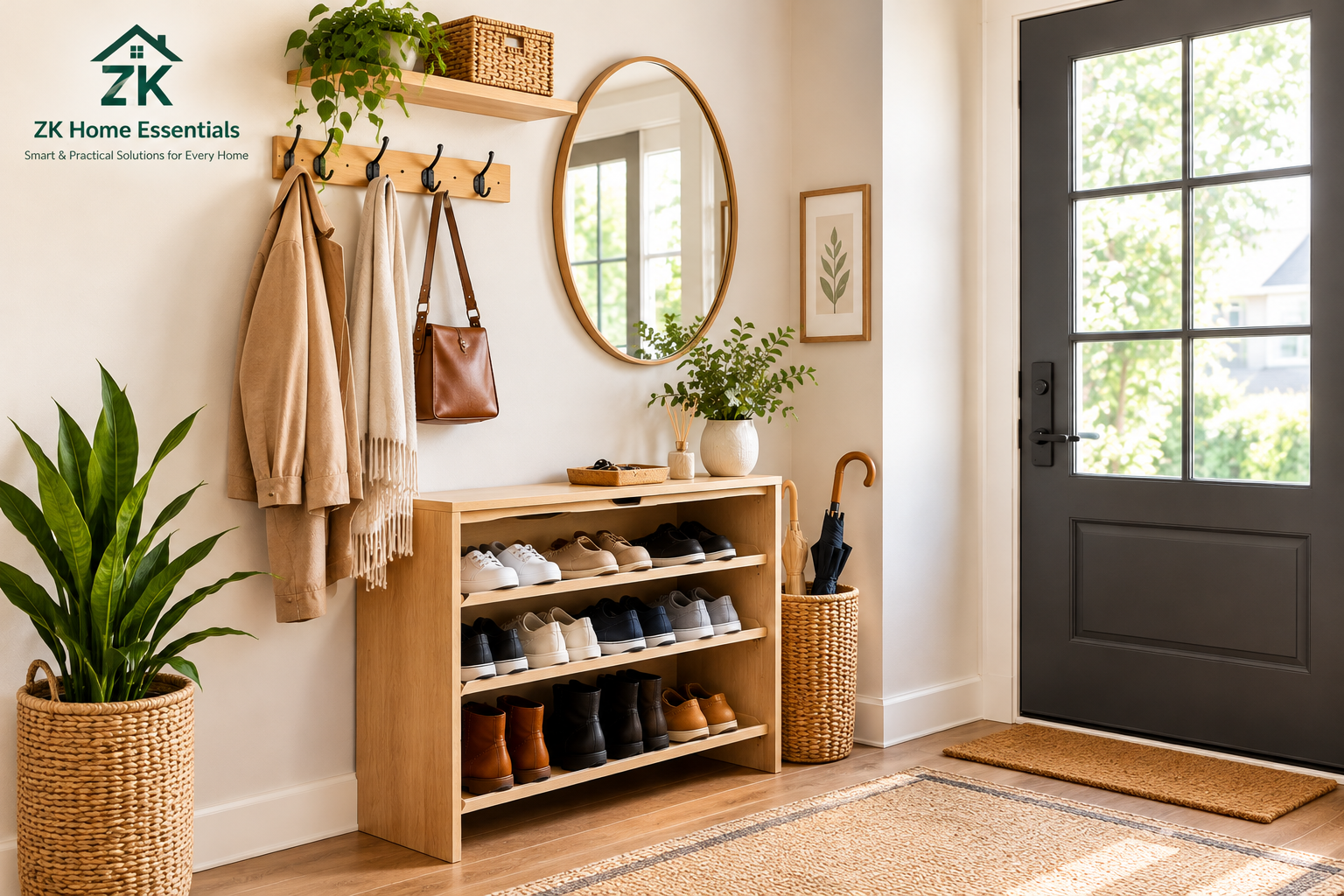
A small entryway can quickly become a crowded drop zone for shoes, coats, bags, keys, and mail. When everything lands near the front door, even a tidy home can feel cluttered before you have taken off your shoes.
The good news is that small entryway organization does not require a large foyer, expensive furniture, or a full home makeover. A few carefully chosen storage solutions and simple daily habits can make a narrow entrance easier to use.
Whether you live in a small apartment, rent your home, or have a front door that opens directly into the living room, these 15 small entryway organization ideas can help you make better use of the space you already have.
These small entryway organization ideas will help you make the most of limited space, keep everyday essentials accessible, and create a more welcoming entrance.
How to Organize a Small Entryway Before Buying Anything
Before purchasing an organizer, identify what actually needs to stay near the entrance. Adding storage without deciding what belongs there can create more clutter rather than solve it.
Start with these steps:
- Clear the entrance. Remove shoes, bags, packaging, mail, and other items that do not need to remain near the door.
- Group similar items. Make separate groups for shoes, outerwear, bags, keys, mail, and pet-walking supplies.
- Measure the available space. Record the usable wall width, floor depth, and clearance needed for doors and drawers.
- Choose your biggest problem. If shoes are the main issue, start with shoe storage. If coats and bags are taking over chairs, prioritize hooks.
- Set a realistic storage limit. Keep frequently used items close to the door and move seasonal or rarely used belongings elsewhere.
Helpful tip: Use painter’s tape or cardboard to mark the footprint of a proposed shoe rack or bench on the floor. Test the door and walk through the space before ordering furniture.
If your entrance opens directly into your living area, explore these small living room organization ideas for more ways to make the most of limited space.
15 Small Entryway Organization Ideas
1. Choose a Slim Shoe Rack
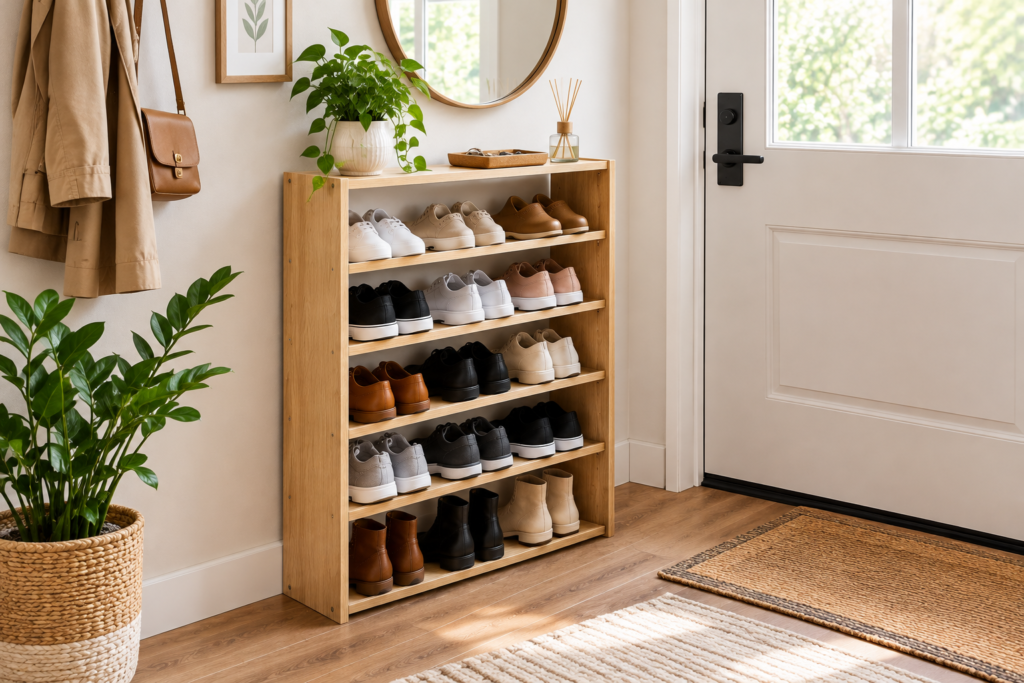
Shoes are often among the first things to accumulate near the front door. A slim shoe rack gives everyday footwear a designated place without requiring a large cabinet.
Look for a rack that fits the available width and depth. A vertical or tiered design may make better use of limited floor space than a wide, single-level rack.
What to look for:
- Dimensions that fit your entrance.
- Enough room for the shoes you wear regularly.
- Shelves that accommodate your usual footwear.
- A stable design that does not wobble during everyday use.
Keep only the shoes you frequently wear near the entrance. Store special-occasion footwear and out-of-season pairs in a closet or bedroom.
Looking for a practical way to keep everyday footwear organized? Explore this multi-layer shoe rack and space-saving shoe storage organizer from ZK Home Essentials. Before ordering, check the product dimensions and available storage capacity to make sure it suits your entryway.
2. Install Wall Hooks for Coats and Bags
When floor space is limited, use the wall for lightweight everyday storage. A row of hooks can hold coats, handbags, reusable shopping bags, hats, or a dog leash.
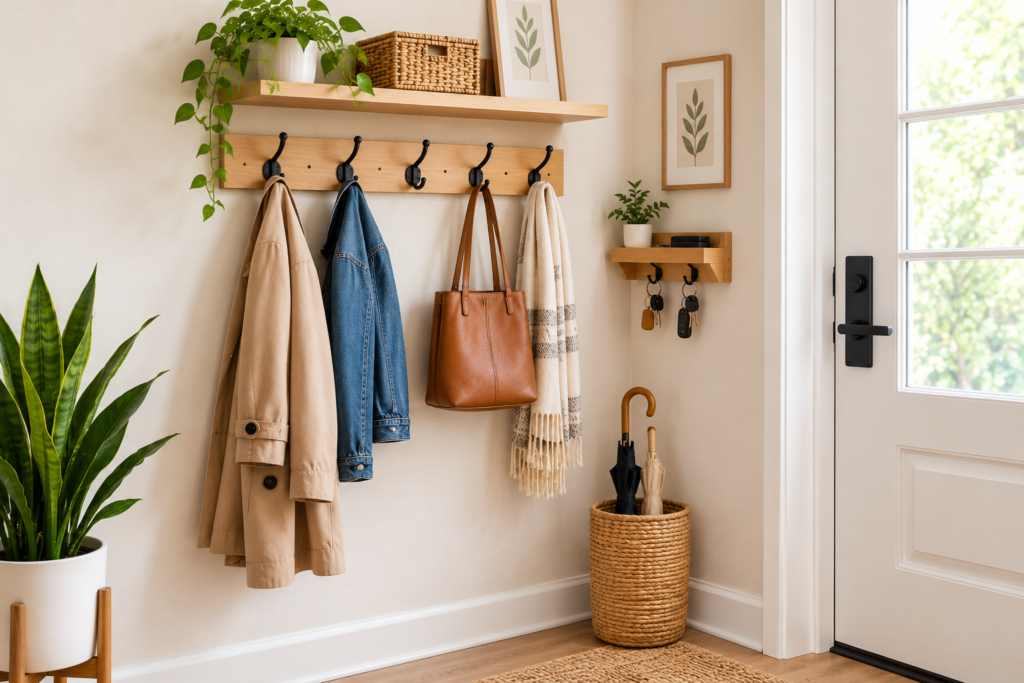
Place the hooks where household members can reach them comfortably. If children use the entrance, consider a lower row for their jackets and backpacks.
Renters should check their lease and the wall-mounting product instructions before drilling. Adhesive hooks can be useful for lighter items, but their capacity depends on the specific product, wall surface, installation, and conditions.
Want to make better use of your entryway hooks? Try this double S-hook hanger for space-saving storage from ZK Home Essentials. It may help you organize compatible hanging items and make better use of your available space. Check the product details to confirm it suits your needs.
Organization tip: Assign each household member a hook or a clearly defined section. This makes it easier to return items to their proper place.
3. Create a Small Key and Essentials Station
Keys, sunglasses, wallets, and earbuds are easy to misplace when they do not have a consistent home.
Create a small landing zone with a shallow tray, a compact shelf, or a wall-mounted organizer. Choose one that fits the items you actually carry rather than a large unit with unnecessary compartments.
You can keep:
- House and car keys.
- Sunglasses.
- A wallet or card holder.
- A small everyday item you need before leaving.
Keep the station away from the door’s swing and avoid displaying spare keys or sensitive information where visitors can easily see them.
4. Use Baskets to Contain Small Items
Small baskets can group items that otherwise scatter across a bench or floor. Depending on your household, one basket might hold reusable shopping bags while another contains pet-walking accessories.
Choose baskets that fit the shelf or cubby where they will be used. Open baskets make contents easy to reach, while lidded containers can help hide items that do not need to be accessed frequently.
Avoid creating too many categories. A few clearly assigned baskets are generally easier to maintain than a collection of containers with overlapping purposes.
5. Make Use of Vertical Space
A small entrance may have more usable wall space than floor space. Use a combination of hooks, a narrow shelf, or a wall organizer to keep frequently used belongings off the floor.
For example, you could arrange your setup like this:
- Upper area: A small basket for seasonal accessories.
- Middle area: Hooks for coats and bags.
- Lower area: A compact shoe rack or shoe tray.
- Near hand height: A small landing shelf for keys and sunglasses.
Before installing anything, consider the door swing, wall material, mounting requirements, and the height of everyone who will use the storage.
6. Consider a Storage Bench If You Have Enough Room
A storage bench can provide a place to sit while putting on shoes and a place to store them afterward. Some models also have shelves, cubbies, or a compartment beneath the seat.
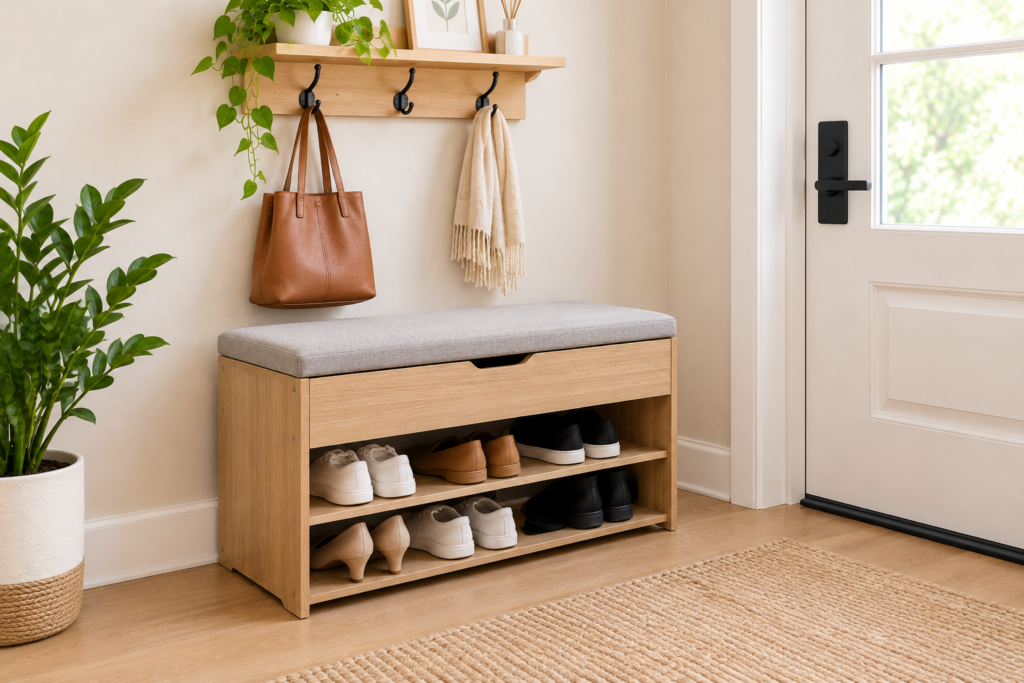
However, a bench is not automatically the best choice for every small entryway. Measure its full depth and account for the space needed to sit, stand, and open any storage compartment.
Choose one only if it leaves a comfortable, unobstructed route through the entrance. If a bench makes the space difficult to navigate, a narrow shoe rack and wall hooks may be more practical.
7. Try Over-the-Door Storage
If your walls are unsuitable for mounting organizers, the back of a suitable door may offer additional storage space.
An over-the-door hook rack can hold lightweight coats, bags, scarves, or other frequently used items. Pocket organizers may work for smaller accessories, depending on their design.
Before buying, check:
- Whether the organizer fits your door thickness.
- Whether the door can close properly with it installed.
- Whether it interferes with hinges, handles, or nearby walls.
- The manufacturer’s stated load limit.
Do not overload an organizer or assume that every door can support heavy items.
Need extra storage without taking up valuable floor space? Explore this behind-the-door hanging organizer with multi-layer storage from ZK Home Essentials. It may help you make use of unused door space for everyday essentials. Check the product dimensions and compatibility with your door before ordering.
8. Add a Mirror Without Crowding the Entrance
A mirror is a useful addition if you want to check your appearance before leaving. It can also reflect light and create a visual impression of a more open space.
A wall-mounted mirror keeps the floor clear. A leaning mirror is another option when there is enough room, but it should be secured appropriately to prevent tipping, especially in homes with children or pets.
If storage is your priority, consider combining a mirror with a narrow shelf or choosing a wall organizer that includes one.
9. Keep Mail and Paperwork Under Control
Mail can quickly turn a small entryway into a paper pile. Instead of leaving envelopes on a console or bench, use a small wall pocket, file holder, or tray.
Create simple categories, such as:
- Action: Bills, forms, or letters that require attention.
- Outgoing: Items you need to post, return, or take with you.
Recycle junk mail promptly. Avoid keeping sensitive paperwork, financial documents, or personal information in an exposed organizer.
A small, clearly defined paper station is usually enough for everyday mail.
10. Use a Shoe Tray for Wet or Muddy Footwear
Rain, mud, and snow can leave floors dirty and slippery. A waterproof shoe or boot tray provides a designated place for footwear that needs to dry or be cleaned.
Choose a tray large enough for the shoes you commonly wear and position it where it will not obstruct the entrance. Clean it regularly and remove standing water rather than allowing it to collect.
If you have a very narrow hallway, consider whether the tray can sit beside a wall or in an adjacent space without reducing the usable walking area.
11. Store Reusable Shopping Bags in One Place
Reusable shopping bags are convenient, but they can become another pile near the door.
Fold them into one basket, place them in a suitable wall-mounted holder, or keep a small collection inside a cabinet. Store the bags you use most often near your normal exit route.
Avoid keeping every promotional tote or spare bag in the entryway. Move extras to a closet or another storage area.
12. Give Children Their Own Drop Zone
Family entrances often need to accommodate backpacks, jackets, lunch bags, shoes, and sports equipment. A simple system can help children put these belongings away without constant reminders.
Try:
- Lower hooks for coats and backpacks.
- A labeled cubby or basket for each child.
- A designated place for shoes.
- One spot for items that must leave the house the next morning.
Keep heavier belongings on stable, suitable storage and ensure that hooks and shelves are securely installed. Avoid placing objects where they could fall onto a child.
13. Choose Multi-Purpose Furniture
If you need several functions in a small area, furniture that serves more than one purpose may help.
Examples include:
- A narrow bench with shoe storage.
- A compact console with drawers.
- A wall shelf with hooks underneath.
- A shoe cabinet with a small top surface for a tray.
Compare the actual dimensions and functions rather than choosing a piece solely because it is advertised as space-saving. Check how far doors, drawers, and stored items extend when in use.
One well-chosen piece may be easier to manage than several separate organizers.
14. Rotate Seasonal Items
A small entryway does not need to hold every coat, pair of shoes, umbrella, and accessory your household owns.
In warmer months, move bulky coats and boots to a closet. During wet or cold weather, make room for the footwear and outerwear you need most.
A practical seasonal system might include:
- Everyday shoes near the door.
- Current-season coats on accessible hooks.
- Extra footwear in a bedroom or closet.
- Rarely used accessories in labeled storage elsewhere.
Review the setup whenever the weather changes or your household’s daily routine changes.
For more ways to store belongings when space is limited, explore these small bedroom organization ideas to make better use of your home’s storage space.
15. Establish a Five-Minute Entryway Reset
Even a well-designed organizer can become cluttered if items are never returned to their places. A short daily reset helps maintain the system without requiring a major cleaning session.
Each evening:
- Return shoes to their rack or tray.
- Hang coats and bags on their assigned hooks.
- Put keys and sunglasses in the designated station.
- Sort or remove incoming mail.
- Take items that belong elsewhere to their proper rooms.
If the reset repeatedly feels difficult, simplify the arrangement. A storage system should fit your routine rather than require constant effort to maintain.
Best Small Entryway Storage Ideas for Different Spaces
Not every entrance can accommodate the same furniture. Use this table to choose a starting point based on your available space.
| Your situation | Practical starting point | What to avoid |
|---|---|---|
| Very narrow hallway | Wall hooks and a small key organizer | Bulky floor furniture |
| Small apartment with no foyer | Slim shoe rack and a compact landing zone | Spreading storage across the room |
| Rental where drilling is restricted | Freestanding storage or suitable over-the-door hooks | Assuming all adhesive products work on every surface |
| Family entrance | Assigned hooks, labeled baskets, and shoe storage | One shared pile for everyone |
| Entrance with frequent wet footwear | A suitable waterproof shoe tray | Leaving standing water on the floor |
| Small entry with a little extra room | Storage bench or compact console | Buying before measuring |
| Entrance with no closet | A combination of hooks, shoe storage, and a small shelf | Trying to store every seasonal item by the door |
Affordable Ways to Organize an Entryway
You do not need to buy a complete matching furniture set to create a useful entrance. Start with the storage that addresses your biggest source of clutter.
Low-cost options
- Reuse a sturdy basket you already own.
- Place a small tray on an existing shelf.
- Repurpose a suitable wall hook or freestanding rack.
- Store only everyday shoes near the door.
- Use labeled containers you already have.
When it makes sense to buy an organizer
Consider purchasing an item when it solves a specific, recurring problem. For example, a shoe rack may be worthwhile if footwear repeatedly blocks the entrance, while a key holder may help if keys are frequently misplaced.
Before buying, compare dimensions, materials, mounting requirements, weight limits, cleaning needs, and return policies. Read the product specifications rather than relying only on styled product photos.
The most useful organizer is the one that fits your actual space and daily routine.
Looking for more practical ways to reduce clutter around your home? Explore these kitchen organization ideas for simple ways to make your kitchen more organized and functional.
Common Small Entryway Organization Mistakes to Avoid
Buying storage before measuring
A shoe cabinet or bench may look compact online but extend too far into your hallway. Measure the available space and account for doors, drawers, and stored items.
Keeping too many things by the door
The entrance is a transition area, not necessarily the best place for every coat, bag, or pair of shoes. Store seasonal and rarely used belongings elsewhere.
Using too many baskets and containers
Containers help only when they have clear purposes. Too many can consume valuable space and make everyday items harder to find.
Ignoring the walking path
Storage should never make entering, leaving, or opening the door difficult. If furniture obstructs movement, choose a smaller piece or move storage to a wall or another room.
Choosing products based on appearance alone
A stylish organizer may not fit your shoes, support your bags, or suit your wall surface. Check dimensions, capacity, installation instructions, and maintenance requirements before purchasing.
Forgetting the daily reset
If items have no assigned home, they will tend to collect wherever space is available. Make each category easy to put away and keep the routine short.
Frequently Asked Questions About Small Entryway Organization
How do I organize a small entryway with no closet?
Start with a slim shoe rack, wall hooks for coats and bags, and a small tray or shelf for keys. Use baskets for selected accessories and store seasonal items elsewhere. If you cannot mount anything, consider suitable freestanding storage or an over-the-door organizer.
What is the best way to store shoes in a small entryway?
Choose storage that matches your available width and depth. A narrow tiered rack, compact shoe cabinet, or bench with shoe storage may work, depending on your space. Keep frequently worn footwear near the door and move other pairs to a closet.
How can I organize a small entryway in a rental?
Check your lease before making permanent changes. Freestanding shoe racks, compact benches, small trays, and compatible over-the-door hooks can provide storage without wall drilling. If you use adhesive hooks, follow the manufacturer’s surface preparation and weight instructions.
What should I keep near my front door?
Keep only the items you regularly need when leaving or arriving, such as everyday shoes, a current-season coat, keys, a frequently used bag, and essential pet-walking supplies. Store extra footwear, seasonal accessories, and rarely used belongings elsewhere.
How can I make a small entryway look bigger?
Keep the floor as clear as practical, choose furniture that fits the space, use vertical storage, and avoid too many decorative items. A mirror may reflect light and create a more open visual impression, but it does not increase the actual floor area.
Are storage benches a good idea for small entryways?
They can be useful when you have enough room for the bench, seating, and clear passage. A bench that is too deep can make an entrance harder to use. Measure carefully and consider a slim shoe rack if floor space is limited.
How do I keep a small entryway organized every day?
Give shoes, coats, bags, keys, and mail a specific place. Return items after use and spend a few minutes each evening clearing the entrance. If clutter keeps returning, reduce the number of items stored there or simplify the system.
Final Thoughts: Make Your Entryway Work for You
A small entrance can be practical and welcoming when every item has a place. Start with the clutter that bothers you most, measure before purchasing storage, and choose solutions that suit your household and available space.
You may need only a shoe rack and a few hooks—or a combination of baskets, a small shelf, and a storage bench. Focus on what makes everyday arrivals and departures easier rather than trying to fit every possible organizer into one area.
For more practical ways to make the most of your home, explore the home organization guides at ZK Home Essentials and choose solutions that fit your space, needs, and budget.
Affiliate disclosure: ZK Home Essentials may include affiliate links in some articles. If you purchase through a qualifying link, the website may earn a commission at no additional cost to you. Recommendations should be evaluated using the product’s current specifications, price, and seller information before purchasing.
For more information about transparent affiliate marketing, read the FTC’s guidance on affiliate and endorsement disclosures. It explains why affiliate relationships should be disclosed clearly so readers understand when a website may earn a commission.